
Published: March 2026 | Category: Luxury Real Estate | Source: Imaani Homes
Ask ten people what luxury living means and you will get ten different answers. A penthouse in Manhattan. A private villa on the coast. A townhouse in a gated community. A serviced apartment in Cantonments with a rooftop pool and a concierge who knows your name.
None of those answers is wrong. But none of them is complete either.
The definition of luxury living has undergone a fundamental shift. What qualified as luxury a decade ago, granite countertops, a high-rise address, a big square footage number, no longer tells the full story. In 2026, the buyers and residents who understand luxury most deeply are not asking how large the property is. They are asking how the property makes them feel.
This article examines what luxury living really means today, how the definition has evolved globally and specifically within Accra’s fast-maturing premium market, and what separates a genuinely luxurious home from one that simply carries a luxury price tag.
Luxury Is No Longer About Size or Status
For much of the twentieth century, luxury in real estate was communicated through scale. Bigger rooms, taller ceilings, more bathrooms, grander facades. It was about visible excess. The goal was to impress others.
That logic is breaking down rapidly.
According to research tracked by McKinsey and Company and cited in emerging housing preference studies from the National Association of Realtors, high-income buyers in 2026 are increasingly prioritising privacy, wellness-driven design, and environments that support slower, more intentional living. In Los Angeles, New York, Dubai, and Accra alike, the question has shifted from “what does this home look like?” to “how does this home feel on a Tuesday afternoon?”
Inman Real Estate’s luxury market analysis for 2026 captured it directly: luxury buyers are no longer focused on what impresses others. They are asking what restores them. They want homes that align with their routines, support their wellbeing, and reflect their values.
The World Luxury Chamber of Commerce, in its 2026 outlook, went further, noting that the definition of luxury is evolving rapidly, shifting from material excess toward emotional richness and personal transformation. That shift is not just philosophical. It is showing up in purchase decisions, design briefs, and the features that command the highest price premiums in prime markets around the world.
The Six Pillars of Genuine Luxury Living in 2026
Luxury living in 2026 is best understood through six interconnected qualities. A property that delivers on all six is genuinely luxurious. A property that delivers on only one or two, regardless of its price point, is simply expensive.
1. Location That Works in Every Direction
True luxury is not just about a prestigious address. It is about a location that removes friction from daily life. Prime locations, as defined by real estate professionals across markets, offer proximity to the things that matter most: international business infrastructure, quality schools, healthcare, fine dining, green space, cultural institutions, and transport.
In Accra, this is precisely why Airport Residential Area commands the premium it does. The neighbourhood sits adjacent to Kotoka International Airport, is surrounded by embassies and multinational headquarters, and provides access to the city’s best hotels, hospitals, and commercial corridors. For an executive, diplomat, or diaspora returnee, the location means less time commuting and more time living. That is a form of luxury that no interior finish can manufacture.
According to Landmark Homes Ghana’s 2026 luxury apartment market analysis, buyers in Accra pay meaningful premiums for proximity to embassies, Grade A offices, international schools, malls, and well-maintained roads, because those locations rent more easily, serve expat and executive needs better, and hold their value more consistently over time.
2. Design That Is Intentional, Not Decorative
Luxury design in 2026 is not about drama or statement pieces. It is about spaces that work for the life being lived inside them. The Dreamer Real Estate 2026 luxury housing analysis describes this as experience-driven living: layouts and materials chosen because they support the daily rhythm of the resident, not because they photograph well for a brochure.
Optima Verdana’s luxury apartment research from January 2026 puts it precisely: luxury begins with openness and light. Floor-to-ceiling windows, open-plan layouts that allow easy movement between living, dining, and working areas, and natural materials that age gracefully rather than trend-chasing. The result is a home that feels elegant and expressive, designed to serve its residents for decades rather than impress for a season.
The hallmarks of intentional design include master en-suites with genuine walk-in wardrobe space, well-proportioned balconies designed for real use rather than symbolic gesture, kitchens planned for actual cooking rather than visual impact, and acoustics that provide genuine quiet. These are not glamorous features. They are the ones that matter most at 7am and 10pm.
3. Amenities That Become Part of Your Routine
There is a meaningful difference between amenities that exist and amenities that get used. The most important question to ask of any luxury development is not what amenities it has, but whether those amenities are genuinely integrated into daily life or simply listed in the marketing material.
According to Landlord Africa’s 2025 Ghana luxury property market analysis, the standard expectations among Accra’s luxury buyers have crystallised around a specific set: infinity pools or rooftop pools with proper design and maintenance, fully equipped modern gymnasiums, concierge services that handle the friction of daily logistics, co-working spaces with reliable connectivity, and landscaped outdoor areas that invite regular use.
Globally, the 2026 luxury buyer has expanded this list. Research from London Bay Homes, Inman, and Dreamer Real Estate all point to wellness infrastructure as the defining amenity shift of the decade. Rather than isolated gym rooms, genuine luxury developments now integrate wellness through natural light, sauna and steam facilities, spa-inspired bathrooms, quiet reading or meditation spaces, and outdoor environments designed for recovery and calm. The Inman 2026 luxury analysis notes that buyers are now investing in recovery spaces, including infrared saunas, steam rooms, and quiet areas for reflection, as foundations rather than extras.
In Accra, the premium commanded by properties with private landscaped courtyards, rooftop infinity pools, and sauna and steam facilities reflects this shift. These are not status features. They are daily-use infrastructure for a life lived well.
4. Service That Removes the Daily Burden
One of the most undervalued dimensions of luxury living is service. Not the white-glove formality of a hotel lobby, but the quiet, reliable management of the building and environment around you so that it never becomes your problem.
A concierge who greets you by name and handles deliveries, maintenance requests, and access coordination means you never have to think about those things. A building management team that maintains the pool, the gym, the generators, and the grounds to a consistent standard means the quality you purchased on day one is preserved in year five.
In Accra’s luxury market, the distinction between well-managed and poorly-managed developments is increasingly stark. According to the Quao Realty 2026 market assessment, safety is a fundamental part of comfort, and high-end buildings must deliver 24-hour surveillance, secured entry points, professional security personnel, on-site management, and maintenance teams who address issues promptly. When that infrastructure is in place, residents are freed from everyday worries. When it is absent, no architectural beauty compensates.
The best developments in Accra now operate closer to a boutique hotel model than a traditional apartment block, with EV charging stations, backup power systems, backup water supply, and concierge desks managed by trained professionals. That level of operational reliability is itself a luxury.
5. Community Without the Loss of Privacy
Luxury in 2026 carries a paradox: buyers want genuine community connection and genuine privacy simultaneously. The era of the impersonal tower block, where residents pass each other in lifts without acknowledgement, is being replaced by thoughtfully designed communities where social life is possible but never forced.
Optima Verdana’s luxury research notes that residents increasingly value connection and belonging as part of their living experience, with curated shared spaces creating natural opportunities to connect with neighbours while still respecting privacy and independence. Sky lounges, co-working spaces, courtyard gardens, rooftop BBQ terraces, and children’s play areas all serve this dual function. They create a reason to be in shared spaces, while the private unit remains a genuine sanctuary.
In a city like Accra, where professional networks matter and community ties are culturally central, this design philosophy is particularly resonant. A well-designed private courtyard or rooftop space can become the most social space in a resident’s week, organically, without obligation.
6. Long-Term Value, Not Just Present Enjoyment
The final dimension of luxury living that separates genuine luxury from expensive living is value: the knowledge that what you have purchased will protect and grow what you paid for it.
In Accra’s prime neighbourhoods, that value proposition is well evidenced. Properties in Airport Residential Area, Cantonments, and East Legon have appreciated 20% to 25% in value since 2020, according to Landlord Africa’s market data. Gross rental yields of 8% to 10% for long-term lets, and up to 19% to 22% for short-term rental strategies, deliver returns that consistently outperform equivalent investments elsewhere in the region.
But value is also about permanence of quality. A luxury home should be built with materials that do not degrade within five years, with systems that function reliably under real-world conditions, and by a developer with the track record and accountability to stand behind their work. In markets where standards vary significantly between developers, this is not a trivial consideration. It is arguably the most important due diligence a buyer undertakes.
What Luxury Living Looks Like in Accra in 2026
Accra’s luxury residential market has matured rapidly. According to Estate Intel’s analysis, Accra has seen a 25% growth in luxury residential developments over the last five years, driven by demand from expatriates, diplomats, and affluent Ghanaians. The standards buyers expect have risen commensurately.
Ghana currently hosts 2,706 high-net-worth individuals with assets exceeding $1 million, according to Landmark Homes Ghana’s market research. The middle class now comprises 46% of the population, substantially higher than the Africa-wide average of 34.3%. Young professionals in finance, technology, oil and gas, and international organisations are earning at levels that make luxury residential a realistic and rational choice rather than a distant aspiration.
What these buyers demand, according to ILLAS Realty’s Accra luxury market analysis, is a specific combination: world-class amenities including fitness centres, swimming pools, and 24-hour concierge; superior finishes with premium imported materials and smart home integration; a prime location in a neighbourhood that enhances rather than complicates daily life; and professional management that maintains quality consistently over time.
Rooftop pools with panoramic city views, private landscaped courtyards, sauna and steam facilities, co-working lounges with high-speed internet, and dedicated children’s play areas are no longer differentiators in Accra’s top tier. They are the baseline expectation. What differentiates the best developments from the merely expensive ones is the quality of execution, the reliability of management, and the long-term credibility of the developer.
The Question Every Luxury Buyer Should Ask
If there is one question that cuts through the marketing language and gets to the real definition of luxury, it is this: does this home make my everyday life better?
Not just on the day you move in. Not just when guests visit. On an ordinary Wednesday morning when you are tired and the week is difficult. Does the space restore you? Is the concierge reliable? Does the rooftop feel like yours? Is the gym actually open and functional? Is the neighbourhood genuinely quiet at midnight?
Luxury that only performs on special occasions is not luxury. It is theatre.
The real definition of luxury living is a home that delivers on its promises every single day, in a location that enhances your life, within a community that supports rather than isolates you, managed by people who take pride in what they have built.
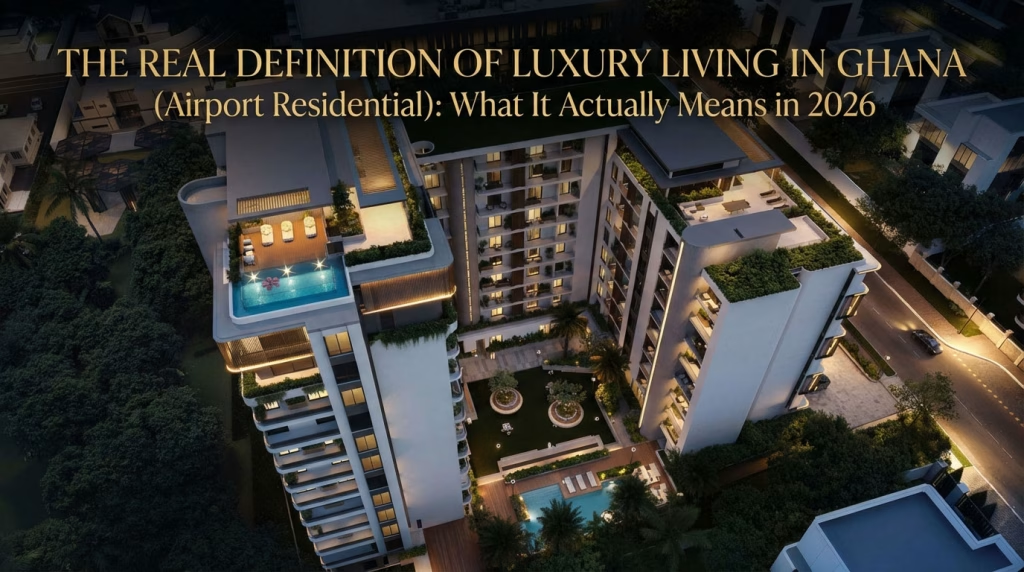
That is the standard Imaani Homes has set for Regalia Residence at Airport Residential, Accra. A private landscaped courtyard. A rooftop infinity pool with 360-degree city views. A sauna and steam room. A concierge service. A co-working lounge. A sky lounge for private events. EV charging stations. A children’s play area. And a developer whose foundations are built on over 25,000 completed construction projects.
To experience Regalia Residence in person, visit regalia.imaanihomes.com or call +233 595 959595.
Sources
This article draws on research and data from: Inman Real Estate News, Luxury’s Next Phase: What the 2026 Buyer Really Wants (November 2025); World Luxury Chamber of Commerce 2026 Luxury Trends Outlook; Dreamer Real Estate, The 4 Key Luxury Housing Trends in 2026 (December 2025); London Bay Homes, 7 Luxury Home Trends for 2026 (February 2026); Optima Verdana, Features That Define Luxury Apartment Living in 2026 (January 2026); McKinsey and Company high-income buyer preference research, cited in Beverly Hills Real Estate Erik Brown Report (February 2026); Landlord Africa, Ghana Luxury Property Trends: A 2025 In-Depth Market Analysis; Estate Intel, Accra Luxury Residential Pipeline Report (2025); Landmark Homes Ghana, Luxury Apartments in Accra: 2026 Price Guide and Ghana Luxury Real Estate Market Analysis; ILLAS Realty, Accra’s Luxury Real Estate Market Analysis; Quao Realty Ghana Market Assessment 2026; Akka Kappa Ghana Luxury Property Listings 2026.