

Updated: June 2026 | Category: Ghana Real Estate | Source: Imaani Homes
Ghana’s economic momentum has continued since this article was first published in March. Inflation has held below 5% through Q2 2026. Diaspora investment continues to accelerate. The data and analysis below remain current and has been verified against the latest available figures.
The Ghana real estate market 2026 is operating at a fundamentally different level than two years ago. The macro chaos of 2022 and 2023 — marked by inflation above 50%, a cedi in freefall, and a government in default — has given way to one of the most stable and investor-friendly environments West Africa has seen in a decade.
For anyone considering buying, investing, or developing property in Ghana right now, the data tells a compelling story. This article breaks down the current state of the Ghana real estate market 2026, using live economic indicators, pricing data, yield benchmarks, and market intelligence from authoritative sources.
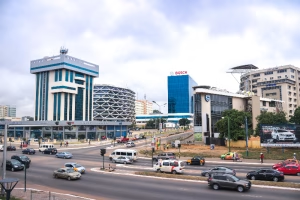
The Macroeconomic Foundation: Why 2026 Is Different
Before examining the property market, it is essential to understand what is driving it. Real estate in Ghana does not move independently of the economy. When the economy contracts and inflation spirals, property transactions seize up. Furthermore, when the economy stabilises and confidence returns, capital flows back into bricks and land. That is exactly what is happening right now.
Ghana’s inflation rate fell to 3.8% in January 2026, according to Trading Economics. This marks the 13th consecutive month of slowing price growth and the lowest reading since the Consumer Price Index was rebased in 2021. To put that in context: inflation was above 54% at its peak in late 2022. The distance the economy has travelled in just over two years is remarkable.
Interest Rates: The Most Important Number for Property Buyers
The Bank of Ghana responded to this disinflation with one of the most aggressive rate-cutting cycles of any central bank in the world. The policy rate was reduced by a cumulative 12.5 percentage points across multiple decisions in 2025 and into 2026.
At its January 2026 Monetary Policy Committee meeting, Governor Johnson Asiama announced a further 250 basis point cut. As a result, the policy rate dropped to 15.5% — its lowest level since February 2022. The Ghana Reference Rate, which commercial banks use to price loans, fell to 15.68% in January 2026, down from nearly 30% at the start of 2025.
Key Economic Indicators Every Investor Must Note
The IMF projects Ghana’s GDP growth at 4.8% for 2026. Moreover, the cedi appreciated by more than 27% against the US dollar in 2025, according to Afreximbank, and was ranked among Africa’s best-performing currencies. Ghana formally exited its debt default in October 2024, reopening access to international capital markets. Public debt dropped from 92.6% of GDP in 2022 to 44.9% by mid-2025.
For property buyers, the significance of these numbers is clear. When inflation stabilises and interest rates fall, property values firm up, transaction volumes increase, and developer confidence returns. That is the precise environment Ghana’s real estate market 2026 is now in.
What Has Changed Since March 2026: The June Update
When Imaani Homes published its March 2026 market report, the policy rate was at 15.5% and inflation had just printed at its lowest level since the CPI was rebased. The picture since then has nuanced in important ways.
The good: The policy rate has fallen further, to 14%. The Ghana Reference Rate is now at 10.03%. Gross reserves have grown. Economic activity data for Q1 2026 came in exceptionally strong. The luxury apartment pipeline continues to expand, with developer confidence holding.
The nuance: Inflation ticked up very slightly to 3.4% in April, breaking a 14-month consecutive decline. The Bank of Ghana has paused its easing cycle. The cedi has softened modestly from its 2025 highs. Goldman Sachs analysts have pushed back their forecasts for the next round of rate cuts to Q3 2026, though they maintain a long-term terminal rate of 12.5%. Oxford Economics expects some inflationary pressure to build in the second half of 2026, linked to global energy price movements from the Middle East conflict.
For property investors, none of this changes the underlying investment case. It does mean that buyers who have been watching and waiting should not assume the macroeconomic tailwinds will continue to strengthen indefinitely. The window of improving conditions is open — but it has a horizon.

Property Prices in Ghana: What the Numbers Say in 2026
According to The Africanvestor, which tracks Ghana’s property market using data from Ghana Property Centre, meQasa, and the Bank of Ghana, the median housing price in Ghana in 2026 is approximately GHS 1,400,000 — equivalent to around $127,000. The average, however, sits at GHS 6,250,000 (around $568,000), skewed upward by luxury listings in prime Accra.
The gap between the two figures reveals how stratified the market truly is. Greater Accra dominates the national market, accounting for 65% of all property transactions in the country.
Airport Residential: The Benchmark for Ghana Real Estate Market 2026 Pricing
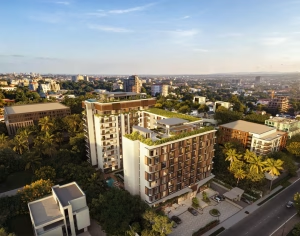
Within Accra, there is a clear pricing hierarchy based on location. Airport Residential Area commands some of the highest prices in the country. Specifically, detached houses range from $500,000 to $1.5 million. Luxury apartments are typically priced from $180,000 to $300,000 for well-appointed units.
The area attracts diplomats, senior executives at multinationals, high-net-worth Ghanaians, and diaspora buyers. These buyers want proximity to Kotoka International Airport and the city’s established business infrastructure. The price per square metre in Airport Residential sits between $1,400 and $1,800. The most prestigious addresses push above $2,000 per square metre.
Other Prime Accra Neighbourhoods and Their Price Points
Cantonments, the traditional diplomatic quarter, maintains strong pricing at $400,000 to $950,000 for houses. Apartments there range from $200,000 to $400,000. East Legon, which is popular with families and returnees, ranges from $300,000 to $700,000 for houses and sees consistent diaspora investor demand.
Ridge and North Ridge carry the legacy premium of Accra’s original high-status addresses — larger plots, more established landscaping, and an understated exclusivity that appeals to buyers who equate prestige with permanence. Houses range from USD 350,000 to USD 800,000. These are long-hold addresses where buyers buy once and rarely sell.
The Premium Mid-Tier: East Legon, Labone, Tse Addo, Burma Hills & East Airport
East Legon is the city’s most active premium residential market by transaction volume. Houses range from USD 300,000 to USD 700,000, with the higher end concentrated in Adjiringanor and the gated estate pockets along the Spintex boundary. The neighbourhood draws consistently from the diaspora buyer segment — families relocating from the UK and USA find in East Legon the combination of good schools, social infrastructure, and a recognisably aspirational address they are looking for. As of early 2026, East Legon is among the neighbourhoods showing the clearest gentrification signals, according to The Africanvestor’s market tracking, with properties in well-presented estates selling in 45 to 90 days in a market where the national average is 90 to 150 days.
Labone punches above its geographic size. A compact, densely desirable neighbourhood at the intersection of the Airport corridor, the sea, and the commercial energy of Osu, Labone offers apartments and townhouses in the USD 180,000 to USD 400,000 range. For buyers who want to be near Kotoka, near the beach, near the best restaurants in the city, and near the Cantonments diplomatic belt — all simultaneously — Labone is one of the few addresses that delivers. Turnkey properties with clean title in Labone consistently attract offers close to asking price, a rarity in the broader Accra market.
Tse Addo is one of the most compelling gentrification stories in Accra right now. Sitting between Cantonments, Labone, and the sea — with Labadi Beach just two kilometres away and Kotoka Airport four kilometres out — Tse Addo occupies a geographic position that should command far higher prices than it currently does. That gap is closing. According to The Africanvestor, Tse Addo has recorded price appreciation of 15% to 25% over the past two to three years, among the strongest gains of any Accra neighbourhood. New apartment developments are pricing from USD 95,000 to USD 119,000 for one-bedroom units, with larger homes reaching USD 300,000 to USD 500,000. The neighbourhood is on a clear trajectory — buyers who move now are paying pre-maturity prices for a location that is repricing upward.
Burma Hills — which overlaps with the Tse Addo and East Airport pocket — is a quiet, elevated residential enclave that has long been favoured by senior professionals and established families who want seclusion without sacrificing proximity. Executive five-bedroom townhouses in Burma Hills are listed at USD 500,000 and above. The neighbourhood’s understated character and genuine calm make it attractive to a buyer profile that has moved past wanting to be seen and simply wants to live well. It is not a high-volume market, but it is a quality one.
East Airport sits within the broader Airport Residential orbit but at a slight pricing discount to the most prestigious Airport addresses — making it a genuine entry point for buyers who want the Airport Residential quality of life without the full Airport Residential price tag. Apartments and townhouses range from USD 150,000 to USD 350,000. The area benefits from the same infrastructure, the same tenant pool, and the same proximity to Kotoka as its more expensive neighbours — and for that reason, it consistently outperforms on yield relative to purchase price.
Tesano — one of Accra’s best-connected mid-to-premium suburbs — offers apartments from USD 70,000 for studios and one-bedrooms, rising to USD 127,000–USD 187,000 for two- and three-bedroom units. Positioned between Kwame Nkrumah Circle and the Airport Residential corridor on the N6 Highway, Tesano delivers proximity to both without the premium of either. Its appeal to professionals, young families, and diaspora buyers who want a quality address at a rational price point is consistent and growing.
The Emerging Tier: Where Infrastructure Is Rewriting Values
These are the neighbourhoods where the most significant price appreciation is happening now, and where forward-looking investors are positioning ahead of the infrastructure catalysts that will drive the next wave of repricing.
East Legon Hills has grown from a speculative fringe into a genuinely viable residential destination within five years. Gated townhouse estates and apartment blocks have brought the infrastructure of managed community living to an area that was previously dominated by self-builds on undeveloped plots. Two-bedroom terrace houses are available from USD 90,000, with three-bedroom and four-bedroom units in well-presented estates ranging from USD 150,000 to USD 250,000. Serviced land plots with title are trading at approximately USD 50,000 to USD 55,000, attracting self-builders and small developers who are still early in the area’s repricing cycle. As of early 2026, East Legon Hills carries one of the highest concentrations of active new-build development in the entire city, according to Africanvestor’s construction activity tracking.
Oyarifa has moved from overlooked to actively sought-after. Its position on the N4 highway toward Aburi — with Adenta and East Legon Hills to the south and the Aburi hills to the north — gives it a lifestyle quality that is increasingly being priced in. Average house sale prices sit around GHS 1.5 million in cedi terms, with a range from approximately GHS 250,000 at entry level to GHS 4,000,000 for premium builds. New gated estates along the corridor, including professionally managed projects like Oyarifa Park, are attracting middle-class families and diaspora buyers who have been priced out of East Legon and Spintex. Road upgrades along the Adenta–Dodowa and Adenta–Aburi stretches are improving commute predictability — which is the single biggest driver of suburban residential demand in any city. Plots in Oyarifa’s better-positioned pockets are now asking GHS 900,000 for titled land.
Oyibi sits further along the corridor from Oyarifa, benefiting from the same N4 highway expansion story and offering a more affordable entry point for land banking. Titled plots are currently available from USD 18,000 in some estates, with house prices ranging from a cedi-denominated GHS 350,000 entry point to GHS 7,000,000 for the most premium stock. The highway expansion connecting this belt to Spintex, Tema Community 23 and 24, and the broader eastern corridor is the defining catalyst. Buyers with a five-to-ten year horizon who purchase correctly titled land at today’s prices in Oyibi are positioning for the same infrastructure-driven repricing that has already played out in East Legon Hills.
Pantang was, until recently, a name most Accra buyers associated with the psychiatric hospital and not much else. That narrative is changing — and the agent of change is credibility, in the form of Trasacco. In July 2024, Trasacco Properties broke ground on Akaya by Trasacco, a 28-acre master-planned estate on the Pantang–Abokobi Road in the Ga East Municipality. Phase 1 delivers 74 homes across two, three, and four-bedroom configurations. Pricing starts from USD 145,000, with homes in the first phase scheduled for completion in 2026. The estate sits minutes from the N4 junction, with stated drive times of 8 minutes to Oyarifa Mall, 10 minutes to Adenta Melcom, and 10 minutes to the University of Ghana. Trasacco’s decision to develop here is the most significant signal the market has received about Pantang’s trajectory. When one of Ghana’s most established and credible developers — with over 50 years in operation and an annual turnover exceeding USD 60 million — commits a 28-acre master-planned estate to a neighbourhood, it is not a speculation. It is a calculated bet on where Accra is growing. For investors and buyers watching where the smart development money is moving, Pantang is now on the map in a way it was not two years ago.
Borteyman deserves serious attention for reasons that go well beyond real estate. Located 22 kilometres from central Accra, Borteyman was transformed by a USD 145 million investment in the Borteyman Sports Complex — a world-class facility commissioned in February 2024 to host the 13th African Games. The complex includes an aquatic centre, tennis courts, indoor arenas for basketball and handball, an athletic track, and a multipurpose dome. Plans are in place for a 50,000-seat national stadium as a second phase. Further, the government’s stated intention is to convert the Borteyman complex into a University of Sports for Development — a permanent anchor institution that would draw students, staff, athletes, and visitors to the area on an ongoing basis. The road network to and around Borteyman was upgraded ahead of the Games and connects the area into the Spintex corridor, Tema Community 23 and 24, and the broader eastern belt. For property investors, the Borteyman story is a classic infrastructure-led opportunity: a previously underdeveloped area receiving a permanent, government-backed institutional anchor with new roads, new visibility, and a growing population of professionals and students who need housing nearby. Land and residential values are still in their early pricing stage. That is precisely why it merits attention now rather than after the market has caught up.
Community 25 — Dawhenya — Prampram forms the outer eastern arc of Accra’s expansion, and the road network connecting this corridor is what makes it a legitimate investment thesis rather than just affordable land far from everything. Tema Community 25 is a well-organised, master-planned suburban area already supported by its own commercial infrastructure — Palace Mall, the C.25 Mall, Greenville Hospital, and established gated estates including Devtraco Courts. Residential plots in Community 25 are available from well under USD 10,000 at the lower end of the market, with serviced plots on the Dawhenya Road asking from GHS 70,000 per plot. Roadside commercial land on Dawhenya Road is considerably higher, reflecting the corridor’s commercial potential. Dawhenya itself sits on the access road connecting Community 25 to Prampram — a coastal town the Ningo-Prampram District is developing into a more formal residential and light-industrial zone, 15 minutes from Tema and 45 minutes from central Accra. The Accra–Tema motorway expansion and the broader eastern corridor road improvements are compressing the effective distance between this belt and the rest of Accra. For buyers with a long horizon and patience for the infrastructure timeline, the Community 25–Dawhenya–Prampram corridor is where Accra’s next suburban expansion wave is building.
Outside Accra
Beyond the capital, the market is active but smaller in investment terms. Kumasi mid-market homes in Ahodwo and Danyame run USD 120,000–USD 250,000. Takoradi coastal properties range from USD 100,000–USD 220,000. Both cities are growing, and both offer genuine opportunity for buyers with local knowledge and networks. For diaspora investors and institutional buyers, however, Greater Accra remains the primary market by liquidity, yield reliability, and long-term capital protection.
Where Prices Are Rising Fastest
The highest appreciation rates in Ghana as of mid-2026 are not entirely in the established prime areas. They are in the corridors where infrastructure investment is compressing distance, improving commute reliability, and creating the conditions for suburban repricing.
According to The Africanvestor’s market tracking, the fastest-rising corridors are the Adenta–Oyarifa–Abokobi belt, the Pokuase–Amasaman corridor, the East Legon Hills–Ashaley Botwe axis, the Borteyman–Spintex–Tema eastern arc, and areas connected to the ongoing Accra–Tema Motorway and N4 highway expansions.
Annual price growth in these zones is running at 12% to 18% in cedi terms, significantly outpacing the 7%–10% average for Greater Accra overall. The driver in every case is the same: infrastructure has pushed these areas past the threshold from “too far” to “genuinely livable,” and gated communities with security, backup power, and water storage have brought middle-class buyers in to validate and accelerate the repricing.
The gentrification story is equally active in the established mid-tier. Tse Addo, Osu, and pockets of Labone and North Ridge are showing the clearest gentrification signals in the city, with estimated price appreciation of 15% to 25% over the past two to three years — driven by the arrival of new amenities, infrastructure improvements, and an influx of higher-income residents and diaspora returnees.
For investors seeking short-term appreciation, the emerging suburban corridors offer the most acute growth story. For investors seeking capital protection, premium yield consistency, and institutional-grade tenant quality, the Airport Residential corridor remains the gold standard.
Peri-urban land banking is Ghana’s highest-upside, lower-capital strategy in 2026. Plots in areas like the Dodowa Road corridor that were priced at GHS 35,000–50,000 at launch are projected to reach GHS 60,000–90,000 within three years, driven by infrastructure completion catalysts. The same principle applies in Oyibi, Dawhenya, and the Borteyman belt — where titled land is still available at prices that will look very different once the road improvements complete and institutional development arrives.
Rental Yields: What Investors Are Actually Earning
Rental yields in Ghana’s prime areas remain highly competitive by both regional and global standards. This is one of the most compelling arguments for investing in the Ghana real estate market 2026.
Gross rental yields in Airport Residential and Cantonments average 8% to 10% annually for well-managed long-term lets, according to data from Quao Realty and Landlord Africa’s 2025 market analysis. Occupancy rates for professionally managed properties in these zones run at 85% to 95%. This is sustained by consistent demand from the expatriate and diplomatic community.
Short-Term Rental Returns: The High-Yield Strategy
Short-term rental strategies, targeting the Airbnb and serviced apartment market, have delivered significantly higher returns. According to Eden Heights’ 2025 investment report, investors in Airport Residential using short-term rental models have recorded gross yields of 19% to 22%. Furthermore, top performers are achieving monthly earnings above $2,200 with occupancy rates of 80% to 90%.
The total ROI combining capital appreciation and rental income is projected at 12% to 15% for 2025 and into 2026 for prime Accra locations. For a market where prime addresses are denominated in dollars and transactions are largely cash-driven, this is a compelling benchmark.

The Luxury Segment: Over 2,000 Units in Ghana’s Real Estate Market Pipeline
Ghana’s luxury residential segment is in a period of rapid supply expansion. According to Estate Intel’s analysis of Accra’s development pipeline, over 2,000 luxury units are currently in various stages of planning or construction across the city. Luxury developments account for 44% of the total residential pipeline tracked, concentrated heavily in Airport Residential Area, Cantonments, and East Legon.
Accra has seen a 25% growth in luxury residential developments over the last five years. This growth is driven by demand from expatriates, diplomats, and affluent Ghanaians. Three developers — Vaal Real Estate Ghana, Libi Homes, and I2 Development — control 44% of the luxury pipeline by unit count.
Why Increased Supply Does Not Mean Oversaturation
This increased supply does not signal oversaturation. Rather, it reflects developers’ confidence that demand from diaspora investors, multinational tenants, and the growing class of affluent Ghanaians will absorb new stock.
The structural driver is persistent. Ghana faces a housing deficit estimated at between 1.8 and 2 million units. At the premium end, the deficit manifests as a shortage of quality, well-managed, amenity-rich residential developments. These are developments that meet the expectations of international-standard buyers — and that gap is far from being filled.
The Diaspora Factor: The Ghana Real Estate Market 2026’s Most Reliable Growth Engine
No discussion of the Ghana real estate market 2026 is complete without addressing diaspora investment. Remittances reached a record $6.65 billion in 2024, according to the Bank of Ghana. Moreover, a substantial share of those flows are directed into land acquisition and property purchases.
Diaspora buyers represent a fundamentally different buyer profile from local purchasers. They tend to buy in cash, bypassing the mortgage market’s high rates entirely. Additionally, they favour serviced apartments in secure, managed communities in prime rental zones such as Cantonments and Airport Residential.
How Diaspora Investment Strategy Has Shifted
Their investment logic has evolved significantly. As noted in the 2025 Landlord Africa market report, diaspora investment has moved away from emotional or sentimental purchases. Instead, buyers now favour ROI-focused strategies with clear yield and appreciation targets.
Foreign direct investment in Ghanaian real estate surged 18% in 2024. Furthermore, foreign investors accounted for nearly 30% of high-end property purchases in Accra in the most recent reporting period. This international capital inflow is one of the primary reasons prime Accra valuations have remained firm. It is also a primary reason they will continue to appreciate as macroeconomic conditions improve further.
Several structural factors make Ghana uniquely attractive to diaspora investors right now:
Dollar-denominated pricing is a built-in advantage. Because prime Accra properties are priced in US dollars, diaspora buyers transact in the same currency they earn. There is no currency conversion risk on the purchase price, and rental income in dollar-pegged terms preserves the value of the investment over time.
Cash transactions bypass the mortgage market entirely. Diaspora buyers who purchase in cash avoid the commercial lending rate environment altogether. At a time when many local buyers are still navigating lending rates in the 20%+ range, the cash buyer has a decisive structural advantage — including on price negotiation.
The Return to Ghana and Year of Return momentum has deepened permanently. Beyond the Year of Return campaign, the structural movement of African diaspora professionals — particularly from the UK, USA, and Canada — considering permanent or semi-permanent relocation to Accra has not reversed. It has matured into a genuine lifestyle and investment thesis. These are buyers who want an Accra base that reflects the standard of living they have built abroad.
Ghana’s political stability is a regional differentiator. In a West Africa where governance risk is a live concern in multiple countries, Ghana’s democratic track record and peaceful transfers of power continue to draw capital from diaspora investors who could theoretically invest in multiple regional markets but choose Ghana for its institutional reliability.
Foreign direct investment in Ghanaian real estate surged 18% in 2024. Foreign investors accounted for nearly 30% of high-end property purchases in Accra in the most recent reporting period. This international capital inflow is one of the primary reasons prime Accra valuations have remained firm even through the economic difficulty — and it is a primary reason they will continue to appreciate.

Construction Costs: Good News for Ghana Real Estate Market 2026 Developers
Ghana’s Prime Building Cost Index (PBCI) hit 3.9% year-on-year in January 2026, according to the Ghana Statistical Service. This is its lowest reading in years and down sharply from 23.7% in January 2025. It represents the ninth consecutive month of declining construction cost inflation.
Labour cost growth fell to 5.4% year-on-year in January. Additionally, on a month-on-month basis, labour costs actually declined by 4.1%, providing meaningful relief for contractors and developers.
What Falling Construction Costs Mean for Off-Plan Buyers
For buyers purchasing off-plan, this context is important. Falling construction costs make it easier for developers to hold pricing, deliver on time, and protect project viability. The cost environment of 2022 and 2023 forced many developers to either delay or reprice. In contrast, the early 2026 environment has materially eased that pressure.
The Mortgage Market: Progress in the Ghana Real Estate Market 2026
Ghana’s mortgage market has historically been one of the most significant constraints on the property sector. With lending rates at 30% or above through most of 2024, formal mortgage financing was simply not viable for the majority of buyers. As a result, the market has been, and remains, predominantly cash-driven in prime segments.
That is changing, however. The Ghana Reference Rate fell from nearly 30% at the start of 2025 to 15.68% by January 2026. Average lending rates dropped from around 32% to between 21% and 22% through 2025, according to central bank data. Bank of Ghana Governor Johnson Asiama has expressed hope that lending rates could reach 10% by the end of 2026. If achieved, that would represent a genuine structural shift in housing affordability.
The Practical Reality for Buyers Today
Until rates reach that level, the practical reality is clear. Most buyers in prime areas will continue to buy in cash or with off-plan payment plans from developers. Nevertheless, the direction of travel is unambiguously positive. Every percentage point reduction in lending rates expands the buyer pool and increases transaction velocity in the broader Ghana real estate market 2026.
The 2026 Investment Thesis: Where the Smart Money Is Going
Structurally, the most compelling Ghana real estate opportunities in mid-2026 fall into three categories:
1. Prime Accra apartments — capital protection and yield consistency. Airport Residential Area, Cantonments, and the Airport corridor remain the gold standard. Dollar-denominated, consistently tenanted, professionally managed, and liquid by Ghanaian standards. For diaspora buyers and institutional-minded investors, this is where you place capital you want to preserve and compound. Gross yields of 8%–10% long-let, 19%–22% short-let for the right product.
2. Mid-market gated townhouses — total return maximisation. The strongest combination of appreciation and yield in the current market. The best units in the USD 150,000–USD 300,000 range in well-managed estates — Tesano, North, North Legon, Haatso, Kaneshie, parts of Spintex — are delivering 18%–26% total returns for hold-and-rent strategies, according to current market analysis. Scarcity is real; the best stock does not wait.
3. Peri-urban land banking — highest upside, patient capital. The Dodowa Road, Pokuase, Amasaman, and Oyibi corridors for buyers with a five-to-ten year horizon and lower initial capital requirements. Infrastructure completion is the catalyst. Returns are asymmetric — modest until the road opens, then significant.
What connects all three is the same principle: structured investment beats speculative buying. The shift in Ghana’s market from informal, relationship-driven transactions to documented, professionally managed investments is the most important structural change happening right now. Investors who align with that shift — who insist on clean title, professional management, and developer track record — will significantly outperform those who do not.
Key Risks Every Investor Must Understand
A complete picture of the Ghana real estate market 2026 must acknowledge the risks alongside the opportunities. Informed investors understand both sides of the equation.
Land administration remains the sector’s most persistent structural challenge. Multiple titling disputes, documentation gaps, and the coexistence of customary and statutory land systems under the Land Act 2020 continue to raise transaction costs. These issues also deter institutional investors who require clean title verification before committing capital. Therefore, any buyer purchasing property in Ghana should verify land titles through the Lands Commission and work with qualified legal counsel.
Currency and Global Risk Factors
Currency risk, while significantly reduced following the cedi’s 2025 appreciation, has not disappeared entirely. Prime properties are priced in US dollars, which provides a natural hedge for diaspora and foreign buyers. However, it introduces exchange rate risk for cedi-earning buyers.
Global economic headwinds — including cocoa price volatility and elevated freight costs from geopolitical disruptions — could create pressure on Ghana’s export revenues and economic confidence. These risks are well-understood by experienced investors and can be managed with appropriate due diligence and professional guidance.
A Message to the Diaspora: This Is the Window
For Ghanaians living in the UK, USA, Canada, Europe, and across the world, 2026 represents a convergence of conditions that will not persist indefinitely.
The cedi has strengthened. Inflation is near-historic lows. Interest rates are falling. The economic recovery is supported by IMF benchmarks and a government that has emerged from default with its credibility intact. Ghana’s gross reserves are at five-year highs. Economic activity data for Q1 2026 is the strongest in years.
At the same time, the luxury residential pipeline is expanding. Supply will increase. Entry prices, while not cheap, are more competitive now than they will be in three to five years as the market matures and competition for quality assets intensifies.
The question diaspora investors ask most often is: is now a good time to buy? The more useful question is: will the fundamentals be better or worse two years from now? On every relevant indicator — macroeconomic stability, currency strength, interest rates, rental yields, political environment — the trajectory points toward a more expensive, more competitive market by 2028. The window is open. It will not stay open at these terms.
What the Ghana Real Estate Market 2026 Means for Different Types of Buyers
The overall picture that emerges from the data is one of a market in genuine recovery, supported by real macroeconomic improvement rather than speculative momentum.
For the Diaspora Professional
For the diaspora professional considering buying in Accra, the combination of factors is compelling. A strengthened cedi, record-low inflation, falling interest rates, and competitive rental yields together make 2026 one of the most favourable entry points in recent memory. Prime addresses are not cheap. However, they are well-priced relative to what they deliver in yield, tenant quality, and long-term capital protection.
For the Local Accra Buyer
For the local Accra buyer, the improving rate environment and easing construction costs create real hope. The gap between aspiration and affordability will narrow over the next 12 to 18 months. Off-plan purchases with developer payment plans remain the most practical route to ownership in premium developments. Several quality projects in the Ghana real estate market 2026 are currently available in this format.
For the Institutional or High-Volume Investor
For the institutional or what we call the serial investor, the investment thesis is straightforward. Ghana’s position as West Africa’s most stable democracy — with a recovering economy, a growing expatriate community, and a chronic housing deficit — makes the case clearly. The execution risk, as always, lies in developer selection, title verification, and the quality of ongoing property management.
The Imaani Homes Portfolio: Built for This Market
Imaani Homes is developing two addresses that directly reflect the opportunities this market presents.
Regalia — Airport Residential Area
Regalia is Imaani Homes’ flagship. A luxury off-plan development in the heart of Airport Residential Area — the address that protects capital, commands premium rents, and attracts the quality of tenant that every investor wants. Set within a private landscaped courtyard with resort-like calm at the centre of the city’s most prestigious corridor, Regalia is designed for buyers who understand the difference between a place to live and an asset that performs.
Studios to penthouses. A stone’s throw from embassies, five-star hotels, Kotoka International Airport, and Accra’s finest dining and business infrastructure.
Alexis Residence — Tesano
Alexis Residence is a boutique collection of modern apartments in Tesano, one of Accra’s most strategically connected neighbourhoods. Thoughtfully designed and finished to a level rarely found at this price point in the city, Alexis Residence offers professionals, investors, and diaspora buyers a premium address without the Airport Residential premium — and with the connectivity, lifestyle, and rental demand profile that makes for a genuinely performing investment.
Studio to three-bedroom configurations available. Rooftop pool, gym, sun deck, gated access, backup power and water.
Frequently Asked Questions
Is Ghana real estate a good investment in 2026? Based on current fundamentals — inflation at 3.4%, policy rate at 14%, a strengthened cedi, and rental yields of 8%–22% depending on strategy — Ghana’s prime real estate market offers one of the most attractive risk-adjusted investment profiles in West Africa. The key is developer selection, clean title, and professional management.
What is the Bank of Ghana policy rate in 2026? As of May 2026, the policy rate is 14%, following five consecutive cuts from 28% in mid-2025. The BoG held the rate steady at its May 20, 2026 meeting, citing global geopolitical uncertainty and a mild uptick in April inflation to 3.4%.
What is the Ghana Reference Rate in May 2026? The Ghana Reference Rate, used as the commercial lending benchmark, was 10.03% effective May 6, 2026 — down from nearly 30% at the start of 2025.
Can diaspora buyers purchase property in Ghana? Yes. There are no restrictions on property ownership by Ghanaian diaspora or foreign nationals in Ghana (with the exception of certain land categories governed by customary law). Dollar-denominated pricing means diaspora buyers transact effectively in their home currency. Legal due diligence and title verification through the Lands Commission are essential for all buyers.
What are the best areas to invest in Accra in 2026? For capital protection and rental yield: Airport Residential Area and Cantonments. For total return combining appreciation and yield: well-located mid-market gated developments in Tesano, parts of Spintex, and East Legon Hills. For long-term land appreciation: peri-urban corridors including Pokuase, Oyarifa, and the Dodowa Road belt.
What rental yields can I expect in Accra? Long-term lets in prime areas: 8%–10% gross. Short-term and serviced apartment models in Airport Residential: 19%–22% gross. Mid-market gated townhouses: 8%–11% gross yield with 10%–15% annual appreciation on top.
How do I buy property in Ghana from abroad? Most diaspora buyers work with a trusted local developer, a Ghana Bar Association-licensed lawyer for due diligence and title verification, and a REAC-verified agent. Off-plan payment plans with reputable developers like Imaani Homes allow structured purchase over a development timeline. Contact Imaani Homes to begin the conversation.
The Ghana Real Estate Market 2026: A Market at an Inflection Point
The Ghana real estate market 2026 is not without its complexities. Nevertheless, the data consistently points in one direction: a market that has worked through its most difficult period and is now positioned for stable, credible growth.
The macroeconomic recovery is real. The diaspora capital is flowing. The construction pipeline is active. Furthermore, the prime locations — particularly in the Airport Residential corridor — continue to attract the kind of tenants and buyers that underpin long-term value.
For investors who have been watching Ghana and waiting for the right moment, the evidence from the Ghana real estate market 2026 suggests that moment is now.
Contact Imaani Homes to discuss your investment → Explore Regalia in Airport Residential Area → Explore Alexis Residence in Tesano →
Sources
This article draws on data and analysis from the following sources: Bank of Ghana Monetary Policy Committee statements (January, March, and May 2026); Trading Economics Ghana interest rate, inflation, and economic data; Ghana Statistical Service Prime Building Cost Index and CPI data (through April 2026); Stanbic Bank Ghana Reference Rate (May 2026); The Africanvestor Ghana Property Price Forecasts and Market Analysis (2026); Landlord Africa Ghana Luxury Property Trends Report (2025); Estate Intel Accra Luxury Residential Pipeline Analysis; Ownkey Ghana Real Estate Trends (April 2026) and Complete Market Guide (Q2 2026); Ghana Property Finder Q1 2026 Market Report; Nairametrics Ghana inflation analysis (May 2026); FX Leaders Bank of Ghana policy rate analysis (May 2026); FocusEconomics Ghana BOG Policy Rate Commentary; AirROI Accra Short-Let Market Data (2026); Eden Heights Ghana Real Estate Market Trends and Investment Report (2025); Diaspora Affairs GH Property Investment Guide (2026); Afreximbank Ghana Economic Outlook; IMF Ghana Country Data and World Economic Outlook (2026); Business and Financial Times Real Estate analyses; Ghanamma Ghana Housing Market Reports.