
Published: January 2026 | Category: Ghana Real Estate Investment | Topic: FDI, Diaspora, Accra Property Market
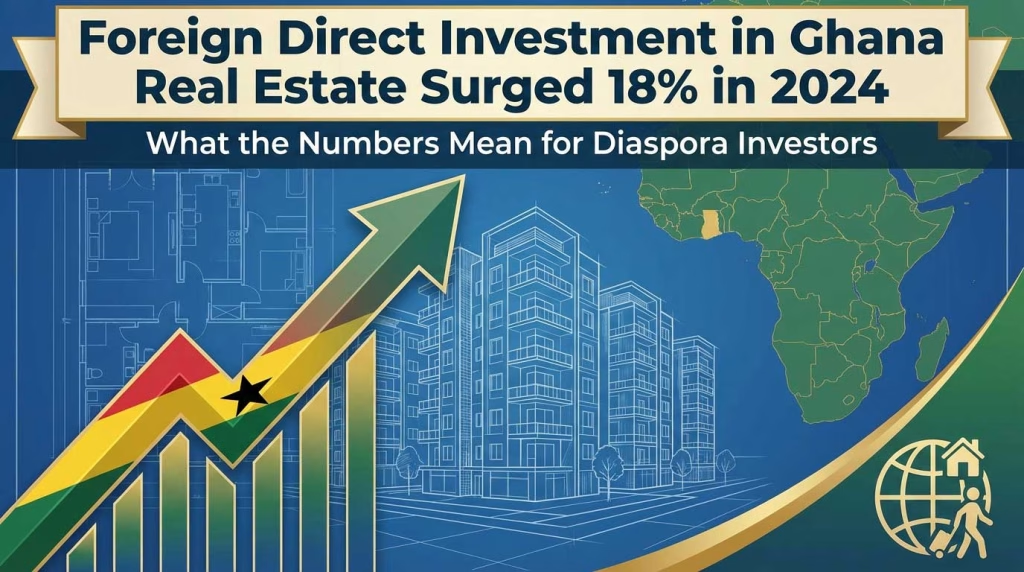
Foreign direct investment into Ghana’s real estate sector surged 18 percent in 2024. That single figure, sourced from Ghana Property Finder and cited across multiple 2025 market analyses, is the headline. But the headline understates what is actually happening in Accra’s property market, because the 18 percent FDI surge is only one of several converging data points that together make a case for Ghana real estate that did not exist three years ago.
For Ghanaians living abroad in the United Kingdom, the United States, Canada, and Europe, this article presents the complete investment picture: the FDI data, the diaspora remittance numbers, the market performance figures by neighbourhood, the rental yield data, and the specific developments where that capital can be deployed in 2026.
The FDI Surge: What 18 Percent Actually Means
The Headline Number in Context
Foreign direct investment into Ghana’s real estate sector surged 18 percent in 2024, according to Ghana Property Finder, with continued increases expected into 2025. This comes after several years of constrained FDI flows driven by Ghana’s 2022 debt crisis. Total FDI into Ghana had dropped to USD 1.3 billion in 2023, a 7.6 percent decline from 2022, according to Macrotrends data cited by Global Finance Magazine. The 2024 real estate surge represents a sectoral breakout ahead of a broader FDI recovery, meaning that international investors chose real estate specifically as their re-entry point into the Ghanaian economy before committing capital across other sectors.
Why Real Estate Led the Recovery
Real estate received preferential investor attention for a straightforward reason: it is one of Ghana’s listed priority investment areas under the Exemption Act of 2022, qualifying for tax incentives. More practically, real estate offers the specific combination that makes sense at the early stage of a post-crisis recovery: hard asset backing, USD-denominated pricing in the prime segment, and demand driven by structural factors such as urbanisation and diaspora flows rather than by cyclical economic conditions.
High-end transactions in Accra grew 4 percent in 2024 while building permits jumped 15 percent year-on-year, according to Landmark Homes. These are supply-side and transaction-side confirmations that the FDI number reflects real activity, not just announced intentions.
What International Investors Are Buying
The Business and Financial Times reported in June 2025 that foreign direct real estate investment in Ghana has concentrated in prime locations in Accra, with Airport Residential Area being one of the focal points. Notable high-rise developments in the area developed with significant foreign capital include Alto (27 floors), Azure (17 floors), and Aqua (10 floors), all located in Airport Residential. The pattern is consistent: international capital flows to the most established, most liquid, most internationally legible addresses in Accra, which means Airport Residential Area, Cantonments, and East Legon.
The Diaspora Numbers: Bigger Than All FDI Combined
USD 6.65 Billion in Remittances
While the 18 percent FDI surge is the headline, diaspora capital is actually the dominant force in Ghana’s property market. Ghanaians living abroad sent USD 6.65 billion in remittances to Ghana in 2024, a 43 percent increase from USD 4.6 billion in 2023, according to Afreximbank data cited across multiple market analyses. This single figure is four times larger than total foreign direct investment into Ghana in the same period, according to the Eden Heights Q3 2025 Real Estate Market Report.
Three million Ghanaians live abroad, primarily in the United States, United Kingdom, and Europe. A significant and growing share of their remittances is being channelled not into consumption but into formal property investment, particularly in prime Accra neighbourhoods. VAAL Ghana’s diaspora investment analysis published in November 2025 found that over 35 percent of 2024 residential transactions in Ghana were made for investment purposes, with diaspora investors a primary contributor.
The Shift from Remittances to Investment
Landlord Africa’s 2025 luxury property market analysis identified a clear and documented trend among diaspora investors: a shift away from emotional property purchases (the family home, the plot of land) toward sophisticated, ROI-focused strategies. Diaspora investors increasingly favour serviced apartments in secure, managed communities located in prime rental zones such as Cantonments and Airport Residential, where they can earn USD-denominated rental income on a professionally managed asset without needing to be physically present in Ghana to manage it.
This shift is significant for the market because it means diaspora capital is flowing into exactly the same product type that international FDI favours: well-specified, professionally managed, amenity-rich apartments in established neighbourhoods.
Two developments are specifically positioned for diaspora investors in 2026. Regalia Residence by Imaani Homes is a new seven-story luxury development in Airport Residential Area, offering Studios to Penthouse Suites priced in USD, with a rooftop infinity pool, gymnasium, sauna, co-working lounge, and concierge service, currently available off-plan. Alexis Residence in Tesano is 90 percent sold, with only 6 two-bedroom apartments remaining. Both are USD-denominated, both are developed by Imaani Homes, and both are available for diaspora buyers without requiring physical presence in Accra to complete a purchase. Contact the sales team at regalia.imaanihomes.com or WhatsApp +233 595 959595.
Market Performance: The Numbers by Neighbourhood
Airport Residential Area
Airport Residential Area has produced some of the strongest investment returns among Accra’s prime neighbourhoods. Prime areas in Accra including Cantonments, Airport Residential, and East Legon have seen property values surge 20 to 25 percent since 2020, according to Landlord Africa’s 2025 analysis. For Airport Residential specifically, Quao Realty’s investor research cites price appreciation of 70 to 90 percent over five-year holding periods for specific high-performing developments, with rental yields reaching 19 to 22 percent for professionally managed short-let operations. Long-term corporate and diplomatic leases generate 7 to 8 percent annual yields with minimal vacancy.
Vacancy rates in Airport Residential and Cantonments are 3 to 5 percent, the lowest in Accra, according to The Africanvestor’s early 2026 data. Properties in these neighbourhoods with professional management find tenants within 30 to 45 days on average.
Cantonments
Cantonments produces 8 to 9 percent yields on long-term leases, according to Eden Heights’ Q3 2025 report. It commands a projected capital appreciation of 38 percent through 2027, making it the preferred address for buyers who prioritise wealth preservation over maximum yield. Properties average USD 2,500 per square metre.
East Legon
East Legon delivers the highest yields among Accra’s prime neighbourhoods at 9 to 10 percent annually, according to Eden Heights data. Entry prices are more accessible than Airport Residential or Cantonments, typically USD 150,000 to USD 250,000 for two and three-bedroom apartments. This makes it the benchmark for diaspora investors who want prime-tier exposure at lower capital commitment.
Overall Accra Market Direction
Property prices in Ghana increased 6 to 10 percent in nominal cedi terms over the 12 months to early 2026, with Greater Accra seeing 7 to 12 percent growth, according to The Africanvestor’s January 2026 price forecast. Apartments and townhouses in gated communities outperformed, growing toward the higher end of that range. Bank of Ghana data showed two-bedroom unit prices up 8.2 percent year-on-year in late 2024.
The Macro Foundation: Why 2026 Is Different
GDP Growth
Ghana’s economy grew at 5.7 percent in 2024, exceeding projections. The third quarter of 2024 saw 7.2 percent expansion, the highest in five years, according to Landmark Homes’ market analysis. Growth is projected to continue at 4 to 5.8 percent through 2025 and 2026.
Inflation at Single Digits
Inflation fell from 54.1 percent in December 2022 to single digits by late 2025 and stood at 3.8 percent in January 2026, according to the Ghana Statistical Service. The Africanvestor’s January 2026 data confirmed December 2025 inflation at 5.4 percent, the lowest in years.
Interest Rate Cuts
The Bank of Ghana cut the policy rate by 650 basis points through 2025, closing the year at 18 percent according to VAAL Ghana’s diaspora investment report. Average lending rates declined to 24.15 percent in August 2025 from 30.07 percent earlier in the year. For diaspora investors who access USD or sterling-denominated mortgages, rates average 11.5 percent, less than half the local-currency rate, according to Eden Heights Q3 2025.
Public Debt Reduction
Public debt fell to 44.9 percent of GDP by July 2025 from 92.6 percent in 2022, according to Eden Heights’ 2026 market predictions. Ghana formally exited default in October 2024, restoring access to international capital markets.
The Housing Deficit as a Structural Floor
Ghana’s housing deficit is estimated at 1.8 million units, according to multiple sources including the Business and Financial Times. Annual demand is cited at over 100,000 units while formal supply significantly lags. This structural undersupply creates a demand floor that supports property values regardless of short-term economic fluctuations. For diaspora investors with a five to ten year holding horizon, the deficit is the single most important structural argument for Ghanaian real estate.
The Non-Resident Ghanaian Card and Investment Facilitation
The Non-Resident Ghanaian Card programme facilitates diaspora property investment through access to local bank accounts and extended 99-year leasehold arrangements, according to Landmark Homes. The Ghana Investment Promotion Centre established a dedicated Diaspora Investment Desk providing advisory services, streamlined registration, and investment facilitation as part of the Ghana Diaspora Engagement Policy launched in December 2023. Foreign investors can acquire property through leasehold arrangements, typically 50-year renewable terms. The government’s digitisation of land records has improved transparency and reduced fraud risk, a factor cited by foreign investors as critical to their confidence in the market.
Practical Considerations for Diaspora Investors
USD Pricing Removes the Currency Risk
Prime Accra real estate is priced in US dollars. This means diaspora investors from the UK, US, Canada, and Europe are purchasing an asset denominated in the same currency as their income or savings. The cedi’s 40 percent appreciation in 2025 does not affect the purchase price of a USD-priced property, but it does improve the translation value of any cedi-denominated rental income or sale proceeds they eventually convert back to their home currency.
Rental Income Structure
Diaspora investors who do not live in Ghana can structure rental income collection through professional property management companies, with income remitted in USD or paid into a local bank account accessible via the Non-Resident Ghanaian Card. Short-let operations targeting business travellers and expatriates at Airport Residential Area achieve occupancy of 70 to 80 percent with monthly Airbnb income reaching USD 3,000 to USD 4,000 for professionally managed units, according to VAAL Ghana’s November 2025 analysis.
Developer Track Record Matters
In a market where land disputes affect 57 percent of court cases according to Eden Heights, and where construction delays are a documented risk, developer track record is the most important due diligence criterion. The safest diaspora investment is a project from a developer who has delivered sold-out projects at the promised standard and on schedule.
Summary
Foreign direct investment into Ghana’s real estate sector surged 18 percent in 2024, reflecting restored international confidence in Accra’s property market following Ghana’s successful debt restructuring, IMF programme compliance, and GDP growth of 5.7 percent. Diaspora remittances of USD 6.65 billion in 2024 dwarf the FDI figure by a factor of four, and an increasing share of that capital is being deployed into formal, ROI-focused real estate investment rather than consumption. Prime Accra neighbourhoods including Airport Residential Area, Cantonments, and East Legon have appreciated 20 to 25 percent since 2020. Rental yields range from 7 to 8 percent on corporate leases to 19 to 22 percent on managed short-let strategies. A housing deficit of 1.8 million units provides the structural demand floor. Inflation is at 3.8 percent. The policy rate has been cut 650 basis points. Public debt has fallen from 92.6 to 44.9 percent of GDP. For diaspora investors with USD capital and a five to ten year investment horizon, the conditions that made Ghana real estate unattractive during the 2022 crisis have reversed, and the conditions that made it compelling for decades before that crisis have resumed.
Sources
Ghana Property Finder: Economic Winds of Change, Ghana’s Economy Reshaping the Real Estate Landscape (January 2025) | Landmark Homes: Ghana’s Luxury Real Estate Market, Why It’s Booming Now (November 2025) | Eden Heights: 2026 Real Estate Market Predictions (November 2025) | Eden Heights: Q3 2025 Real Estate Market Report (November 2025) | The Africanvestor: 10 Statistics for the Ghana Real Estate Market (2025) | The Africanvestor: Property Price Forecasts Ghana (January 2026) | VAAL Ghana: Diaspora Investment in Ghana Real Estate (November 2025) | Landlord Africa: Ghana Luxury Property Trends 2025 (August 2025) | The Business and Financial Times: How Foreign Direct Real Estate Investment is Shaping Property Market (June 2025) | The Business and Financial Times: Real Estate Renaissance, Growth Drivers and New Frontiers (March 2026) | Global Finance Magazine: Ghana, Waiting for FDI (May 2025) | MyJoyOnline: Accra’s Luxury Apartment Market Trends and 2025 Outlook | Afreximbank: Ghana Diaspora Remittances 2024 | Bank of Ghana | Ghana Statistical Service