
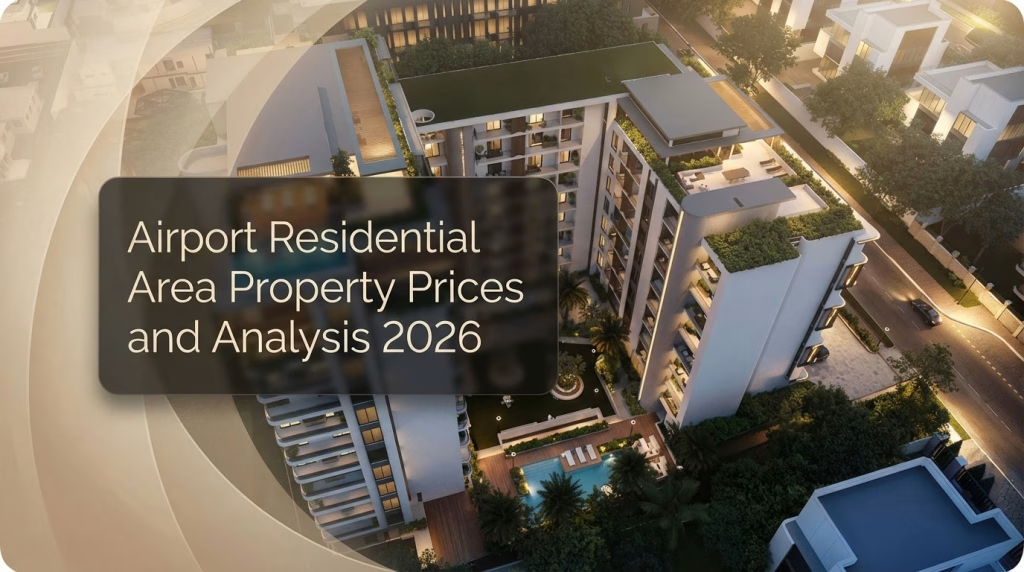
Published: March 2026 | Category: Accra Real Estate | Topic: Airport Residential Area, Property Prices, Investment Analysis
Airport Residential Area remains Accra’s most consistently sought-after address for expatriates, diplomats, multinational executives, and diaspora investors in 2026. It is not the market’s highest-yielding neighbourhood, nor its fastest-appreciating. What it offers instead is something rarer in Ghana’s property landscape: low vacancy, reliable tenant quality, USD-denominated pricing, and a structural demand floor driven by the concentration of embassies, NGOs, Grade-A offices, and Accra International Airport in a single compact district.
This article presents the current sale prices, rental rates, yield data, and investment outlook for Airport Residential Area, drawing on market data published through early 2026.
The Market at a Glance
Airport Residential Area is one of Accra’s highest-priced neighbourhoods on a per-square-metre basis. The Africanvestor’s January 2026 best areas analysis puts prime Accra apartment prices at GHS 24,000 to GHS 32,000 per square metre for quality stock in top-tier neighbourhoods, which translates to roughly USD 1,500 to USD 2,000 per square metre at current exchange rates. The Africanvestor’s separate 2026 housing price report puts the Accra-wide median price per square metre for apartments at GHS 16,300 (approximately USD 1,482), with Airport Residential and Cantonments carrying the highest per-square-metre values in the city.
TheAfricanvestor specifically identifies Airport Residential Area as one of Accra’s three most expensive areas to buy, alongside Cantonments and East Legon, and notes that prices here are supported by a distinct and defensible demand base that other neighbourhoods cannot replicate.
Sale Prices: What You Pay in 2026
Apartments
Well-specified two-bedroom luxury apartments in Airport Residential typically range from USD 180,000 to USD 280,000 in 2026, depending on amenities, floor level, and building brand, according to Landmark Homes’ 2026 luxury apartment price guide. The upper end of this range applies to newer developments with full amenity packages including rooftop pools, gyms, concierge, backup power and water, and EV infrastructure.
Active listings on Ghana Property Centre confirm this range in practice, with two-bedroom apartments priced from USD 150,000 for older or less-specified stock to USD 260,000 for premium ready-to-move-in units. A well-positioned East Airport two-bedroom in a serviced residence is listed at USD 180,000. A premium upper-floor two-bedroom with unobstructed views and high-specification finishes is listed at USD 250,000. A higher-tier two-bedroom with pool, gym, and 24-hour security is listed at USD 220,000. The Ghana Property Centre market report puts the average asking price for houses in Airport Residential at approximately GHS 20,903,038 (around USD 1.9 million), which reflects the weight of large detached and compound properties in that category.
For three-bedroom and larger apartments in Airport Residential, pricing runs from USD 250,000 to USD 400,000 for high-end stock, with some branded or ultra-luxury projects exceeding USD 2,000 per square metre, according to the MyJoyOnline luxury apartment market analysis.
Houses and Townhouses
Three-bedroom detached houses in Airport Residential Area range from USD 450,000 to USD 600,000, according to both Ghana Property Finder’s 2026 area guide and the Ghana property price comparison published by Enmaa in January 2026. The upper end of this range and above applies to larger executive houses on titled plots in West Airport and Airport Hills.
Active listings illustrate the spread: a three-bedroom self-compound house at East Airport is listed at USD 300,000, a four-bedroom executive at USD 350,000, a five-bedroom house at Airport Hills at USD 1.2 million, and a seven-bedroom fully furnished house at USD 2.5 million. Commercial land in the area has reached USD 4 million per acre for titled plots in prime positions.
For luxury villas at the high end, Enmaa’s January 2026 report puts four to five-bedroom villas at GHS 12,000,000 to GHS 30,000,000 (USD 1.09 million to USD 2.73 million) for 350 to 600 square metres in prime areas including Airport Residential.
Rental Rates: What You Earn in 2026
Long-Term Corporate and Diplomatic Leases
Airport Residential is a USD-denominated rental market in its prime segment. Expat-heavy areas like Airport Residential and Cantonments quote rents in US dollars, according to The Africanvestor’s early 2026 Accra rents guide, while local tenants in outer areas pay in cedis on one to two year advance terms.
For apartments on long-term leases targeting corporate and diplomatic tenants, the current market rates are:
One-bedroom furnished apartments at West Airport are listed from USD 1,200 per month. Two-bedroom furnished apartments range from USD 1,200 to USD 1,500 per month for mid-market stock and from USD 1,800 to USD 2,500 for premium fully serviced units. One listing on Ghana Property Centre shows a fully furnished two-bedroom duplex at Airport Residential at USD 3,800 per month. Three-bedroom apartments in premium serviced developments are listed from USD 2,200 to USD 2,500 per month for long-term leases, with the best-specified units at Villagio Primavera reaching USD 2,500 per month.
According to Ghana Bound’s August 2025 investor analysis of Airport Residential, the average rent on meQasa listings for the area was GHS 40,136 per month (approximately USD 3,521 at the August 2025 rate), reflecting the weight of larger premium units in the active market. The Africanvestor’s 2026 data shows that two-bedroom apartments in the top three Accra neighbourhoods including Airport Residential commonly rent for GHS 8,000 to GHS 20,000 per month (USD 510 to USD 1,280) at the mid-market band.
For standalone houses and townhouses, the market runs higher. A four-bedroom executive townhouse in Airport Residential is listed at GHS 60,296 per month (approximately USD 5,480) furnished. The Africanvestor cites three-bedroom apartments and larger units targeting senior executives and families renting for USD 2,500 to USD 4,000 per month.
Short-Let and Serviced Apartments
Airport Residential outperforms most Accra neighbourhoods on short-let rates due to its proximity to the airport. Business travellers arriving and departing through Accra International Airport drive consistent demand for short-stay units. VAAL Ghana’s November 2025 diaspora investment analysis puts monthly Airbnb income for professionally managed units in Airport Residential at USD 3,000 to USD 4,000, with occupancy rates of 70 to 80 percent.
The Africanvestor’s 2026 best areas analysis specifically identifies Airport Residential as a short-term rental demand driver noting that late arrivals and early departures create consistent booking patterns distinct from leisure-driven markets like East Legon.
Rental Yields and Investment Returns
Long-Term Yield
Ghana Property Finder’s Airport Residential Area guide puts rental yields at 7 to 8 percent for serviced one and two-bedroom apartments on long-term leases, driven by consistent expat and corporate demand. This is in line with the broader prime Accra market. Eden Heights’ Q3 2025 Real Estate Market Report puts Airport Residential and Cantonments yields at 8 to 9 percent, with East Legon slightly higher at 9 to 10 percent.
The Africanvestor’s early 2026 analysis of whether it is a good time to buy in Accra notes that central Accra houses showing a gross rental yield of roughly 11 percent suggest prices are not wildly disconnected from rental fundamentals. For Airport Residential specifically, the price-to-rent relationship supports long-term yields in the 7 to 9 percent range depending on acquisition price and unit specification.
Short-Let Yield
Short-let operations managed professionally can generate 19 to 22 percent gross rental yields in prime Accra locations including Airport Residential, according to multiple sources including Quao Realty and VAAL Ghana. These yields require professional management and active occupancy optimisation, and carry higher operational cost structures than long-term leases.
Capital Appreciation
Annual capital appreciation in Airport Residential sits at 8 to 10 percent, according to Ghana Property Finder’s 2026 area guide, positioning it alongside Cantonments and East Legon in Accra’s prime appreciation tier. Enmaa’s January 2026 report notes that neighbourhoods near the airport have recorded annual price growth of 10 to 15 percent, the highest in Accra. Over the five-year period from 2020 to 2025, prime areas in Accra including Airport Residential appreciated 20 to 25 percent in aggregate, according to Landlord Africa’s 2025 luxury market analysis.
Vacancy and Liquidity
Airport Residential and Cantonments carry vacancy rates of 3 to 5 percent, the lowest in Accra, confirmed across multiple sources including The Africanvestor’s January 2026 data and Ghana Property Finder’s 2026 area guide. The Africanvestor specifically notes that vacancy in these prime areas is stable to declining in early 2026, as demand from embassies, NGOs, and corporate tenants keeps quality units occupied.
One indicator of market tightness: landlords in Airport Residential and Cantonments are increasingly able to demand 12 to 24 months of advance rent without losing tenants, according to The Africanvestor’s early 2026 analysis of Accra’s rental market. This would not occur in an oversupplied market.
Well-priced rentals in prime areas are leasing in two to eight weeks for clean, professionally managed properties, according to The Africanvestor. Overpriced or poorly maintained units sit for three to six months.
Investment Considerations for Buyers in 2026
What Supports Price Stability
Airport Residential has a structural demand floor that most Accra neighbourhoods lack. The area houses embassies, high commissions, and international organisations that produce long-term, creditworthy tenants who renew leases and pay in USD. Airport City directly adjacent generates sustained demand from corporate tenants. The airport itself, renamed Accra International Airport in February 2026, handles 3.4 million passengers annually and drives consistent short-let demand.
Land supply is constrained. Airport Residential is a mature, low-density neighbourhood with no large parcels of developable land remaining. New supply enters the market only through redevelopment of existing plots, which is capital-intensive and slow. This constraint is a key reason the neighbourhood has held value through Ghana’s economic volatility.
What Investors Should Watch
Not all sub-zones perform equally. East Airport, which extends toward Spintex, is a distinct sub-market from the classic West Airport grid closer to Liberation Road and Airport City. Buyers focused on corporate and diplomatic tenant demand should prioritise West Airport and the established grid. East Airport offers more accessible entry prices but somewhat lower tenant quality and yield consistency.
Flight-path noise is a real consideration in some blocks. Properties directly under approach and departure corridors experience noise during peak morning and evening schedules. East Airport gated communities and West Airport buildings set back from the flight path are quieter. This affects both tenant satisfaction and resale liquidity.
Service charges vary significantly across developments and should be factored into net yield calculations. Monthly service charges covering 24-hour security, generator backup, pool and gym maintenance, water systems, and landscaping add meaningful ongoing costs. Registration, legal, and due diligence fees typically add 3 to 5 percent to the acquisition price, according to Landmark Homes.
Developer Track Record
In a market where land disputes affect 57 percent of court cases according to Eden Heights, developer reputation and title quality are the most important due diligence criteria. Off-plan purchases should be made only with developers who have delivered completed, occupied projects that match their original specifications. In Airport Residential specifically, buyers should conduct independent title searches and legal review of sale agreements before committing to any purchase regardless of developer brand.
Airport Residential vs. the Prime Tier
Airport Residential is not the cheapest entry point into Accra’s prime market, nor does it deliver the highest headline yields. East Legon offers more accessible prices, slightly higher rental yields at 9 to 10 percent, and a lifestyle that attracts families and the local professional class. Cantonments offers comparable yields and prestige but with a smaller, more embassy-focused tenant base.
What Airport Residential offers that neither can match is airport proximity. For investors targeting the corporate travel, business executive, and senior expatriate tenant profile, the ten-minute drive to Accra International Airport is a non-negotiable requirement that eliminates other neighbourhoods from consideration. This creates a captive, repeat-demand tenant base that produces the area’s low vacancy and stable long-term yields.
The Africanvestor’s January 2026 summary identifies Airport Residential as one of the three areas where the combination of yield, appreciation, and demand stability justifies the premium entry price. Ghana Bound’s investor FAQ specifically concludes that Airport Residential is not the place for quick, high-yield returns, but for investors seeking long-term security in one of Accra’s most defensible addresses, it remains unmatched.
Regalia Residence by Imaani Homes is a new seven-story luxury development in Airport Residential Area, currently available off-plan. Residence types range from Studios to Penthouse Suites across five unit configurations, with pricing in USD. Amenities include a rooftop infinity pool, gymnasium, sauna and steam room, co-working lounge, concierge service, basement parking, EV charging, and a private landscaped courtyard. Imaani Homes has delivered two prior sold-out projects, JAK Royale and The Ivy Townhomes, and Alexis Residence Tesano is currently 90 percent sold with only 6 two-bedroom units remaining. For pricing and availability: regalia.imaanihomes.com or WhatsApp +233 595 959595.
Summary Data Table: Airport Residential Area 2026
| Metric | Range / Figure | Source |
|---|---|---|
| 2BR apartment sale price | USD 150,000 to USD 280,000 | Landmark Homes, Ghana Property Centre |
| 3BR house sale price | USD 450,000 to USD 600,000 | Ghana Property Finder, Enmaa |
| Price per sqm (apartments) | USD 1,500 to USD 2,800 | The Africanvestor, TheAfricanvestor |
| Long-term rental yield | 7 to 9 percent | Ghana Property Finder, Eden Heights |
| Short-let rental yield | 19 to 22 percent | VAAL Ghana, Quao Realty |
| Annual capital appreciation | 8 to 15 percent | Ghana Property Finder, Enmaa |
| Vacancy rate | 3 to 5 percent | The Africanvestor, Ghana Property Finder |
| 2BR rent (long-term) | USD 1,200 to USD 2,500/month | Ghana Property Centre listings |
| 3BR rent (corporate/diplomatic) | USD 2,200 to USD 4,000/month | Ghana Property Centre, The Africanvestor |
| Short-let monthly income | USD 3,000 to USD 4,000 | VAAL Ghana |
| 5-year capital appreciation (2020-2025) | 20 to 25 percent | Landlord Africa |
Sources
Ghana Property Finder: Airport Residential Area Guide, East and West Airport Living (February 2026) | Landmark Homes: Luxury Apartments in Accra, 2026 Price Guide | The Africanvestor: Housing Prices in Ghana (January 2026) | The Africanvestor: Exact Rents in Accra (January 2026) | The Africanvestor: Best Areas to Buy Property in Ghana (January 2026) | The Africanvestor: Is 2026 a Good Time to Buy Property in Accra? (January 2026) | Eden Heights: Q3 2025 Real Estate Market Report (November 2025) | VAAL Ghana: Diaspora Investment in Ghana Real Estate (November 2025) | Landlord Africa: Ghana Luxury Property Trends 2025 (August 2025) | Ghana Bound: Airport Residential Area, Accra, History, Market, ROI and Investor FAQ (August 2025) | Enmaa: Ghana Property Prices, Accra vs Regional Cities (January 2026) | Ghana Property Centre: Active Listings Data, Airport Residential Area (March 2026) | MyJoyOnline: Accra’s Luxury Apartment Market, Trends and 2025 Outlook | Bank of Ghana